OFDM: Principles and Implementation
Introduction
Orthogonal Frequency Division Multiplexing (OFDM) is a modulation technique used for encoding digital data on multiple carrier frequencies. It has become a popular scheme for wideband digital communication, utilized in various applications such as digital television, audio broadcasting, DSL internet access, wireless networks, power line networks, and 4G/5G mobile communications.
Why Use OFDM?
OFDM offers several advantages which make it suitable for modern communication systems:
Overcoming frequency selective fading and multipath distortions found in wideband channels.
Simplified channel estimation and equalization, which can occur independently at each subcarrier.
Efficient resource sharing across multiple data streams.
Compatibility with MIMO (Multiple Input Multiple Output) and Massive MIMO systems, where each subcarrier experiences flat fading, simplifying equalization to a single tap per subcarrier.
High spectral efficiency, maximizing the data rate within a given bandwidth.
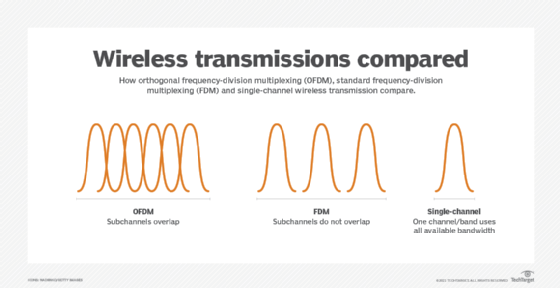
Comparison of OFDM and FDM examples.
From FDM to OFDM
OFDM is derived from Frequency Division Multiplexing (FDM), which involves dividing available bandwidth into non-overlapping subchannels, each carrying a separate signal. FDM uses guard bands between channels to prevent interference.

Example of Frequency Division Multiplexing (FDM) with guard bands.
Unlike FDM, OFDM allows the subcarrier signals to overlap, which increases bandwidth efficiency. These signals are orthogonal, meaning they do not interfere with each other. Orthogonality ensures that the peak of one signal coincides with the nulls of other signals, allowing them to be independently demodulated.
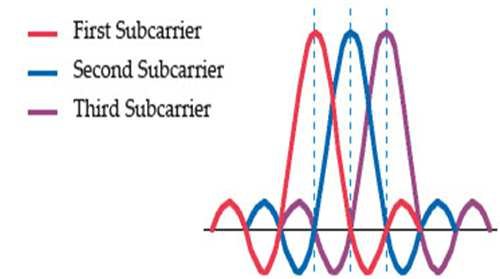
OFDM signal example showing overlapping subcarriers.
Advantages and Challenges
Major Pros of OFDM:
Better bandwidth utilization compared to traditional FDM.
Higher data transmission rates due to the overlapping subcarriers.
Effective integration with MIMO technologies for improved signal reliability and network capacity.
Cons:
Synchronization challenges among the subcarriers and overall system can complicate the implementation.
Conclusion
OFDM is a robust modulation format that addresses several challenges inherent in modern digital communication systems. Its ability to handle high-speed data transmission over complex channels makes it essential for the backbone of current and future wireless technology deployments.