Setting Up a 5G Network Using OpenAirInterface (OAI)
Overview
Setting up a 5G network using OpenAirInterface (OAI) involves several detailed steps, from hardware and software requirements to testing the complete system. This guide will outline each step, providing insights into the necessary configurations and components.
Hardware and Software Requirements
The initial step involves confirming the hardware and software prerequisites:
User Equipment (UE): Modems, smartphones, etc.
Programmable SIM Cards
Software-Defined Radio (SDR) Boards
OpenAirInterface Software
Note
The specific requirements can vary depending on the deployment scenario.
Radio Access Network (RAN) Setup
Setting up the RAN is crucial and involves configuring the gNodeB and UE. OAI software supports this with a general-purpose computing platform and various SDR platforms.
Layer 1 Simulation Framework: Allows functional tests without an RF board by using software communication.
Layer 2 Simulation Framework: Enables testing of large numbers of UEs by connecting OAI UE with OAI xNB via the nFAPI interface.

Layer 2 Simulation Framework Diagram
Core Network (CN) Setup
The Core Network setup includes configuring several network functions (NFs):
Function |
Description |
|---|---|
AMF (Access and Mobility Management Function) |
Manages mobility, registration processes, user access, and resource allocation. |
SMF (Session Management Function) |
Central to establishing, modifying, and terminating user sessions. |
UPF (User Plane Function) |
Handles the transmission of user data packets, ensuring quality of service. |
NRF (Network Repository Function) |
Maintains a repository of Network Functions and their services. |
AUSF (Authentication Server Function) |
Responsible for authenticating the user’s identity. |
UDM (Unified Data Management) |
Manages subscriber data, access authorization, and user registration. |
UDR (Unified Data Repository) |
Stores application and user data across multiple functions. |
NSSF (Network Slice Selection Function) |
Assists with the selection of Network Slice instances for devices. |
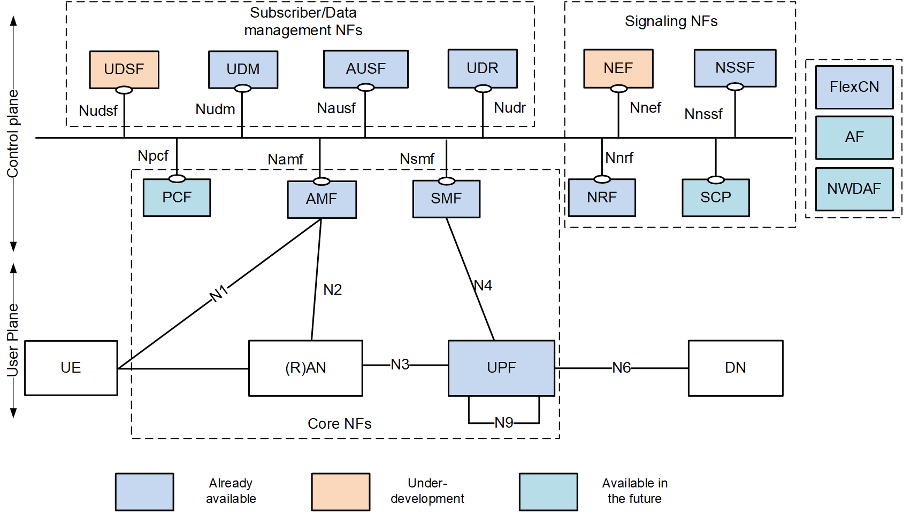
Network Diagram
Deployment Using Docker-Compose
Deployment of the OAI 5G network utilizes Docker-Compose, enabling cloud-native features such as FQDN/service exposure for better network function availability and load balancing.
Configuration and Testing
Once deployed, the network requires configuration, which varies by scenario. Testing then follows to ensure all network components function correctly:
Testing Steps: - Checking signal integrity - Verifying data plane functionality - Ensuring correct signaling message exchanges
User Registration and Traffic Exchange
In a complete setup:
User Registration: UE registers with the 5G Core Network, establishes a PDU Session.
Traffic Exchange: Verifies that the UE can successfully connect and exchange data using tools like ping and iperf.
Monitoring and Optimization
After the network is set up and the user registration and traffic exchange are confirmed, ongoing monitoring and optimization play a vital role in maintaining high performance and reliability. Here are key strategies and tools used in OAI to achieve these objectives:
Network Monitoring: Monitoring tools are essential for observing network operations and detecting potential issues before they affect service. Key metrics to monitor include signal strength, data throughput, and packet loss.
Performance Optimization: Performance tuning involves adjusting network parameters to meet the desired quality of service (QoS) and quality of experience (QoE) goals. Optimization might involve tweaking RF parameters, modifying scheduling algorithms, or adjusting traffic management settings.
Capacity Planning: As network usage grows, it’s important to plan for capacity upgrades. Predictive analytics can be used to forecast future network load and determine when additional resources (like more gNodeBs or expanded core network capabilities) are needed.
Fault Management: Implementing robust fault management procedures is critical for minimizing downtime and service disruption. This includes setting up automatic failover systems, redundancy, and quick recovery processes.
Security Measures: Ongoing security assessments ensure that the network remains protected against both internal and external threats. This includes regular updates to security protocols, encryption standards, and compliance with the latest 5G security guidelines.
These tools and strategies ensure that the OAI-based 5G network remains robust, secure, and capable of handling the evolving demands of users and devices.
Conclusion
The setup of a 5G network using OAI is comprehensive, involving multiple layers and components from the hardware to the application layer. This guide provides a foundational understanding, preparing users for real-world implementations and troubleshooting.