SDR Hardware Overview
Overview
This submodule provides a comprehensive overview of the hardware components commonly used in Software Defined Radios (SDR). A thorough understanding of these components is crucial to grasp the functionality and construction of SDRs.
Essential Hardware Components
RF Front-End
The RF front-end is the primary interface between the antenna and the digital components of the SDR. It typically includes amplifiers to boost signal strength, filters to isolate specific frequency bands, and mixers to shift signal frequencies.
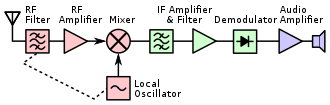
RF Front-End Circuit Diagram
Analog-to-Digital Converters (ADC)
ADCs play a pivotal role in SDRs by converting the analog signals received from the RF front-end into digital signals. The resolution and speed of the ADC determine the quality and bandwidth of the received signals.
Digital-to-Analog Converters (DAC)
DACs are used in SDRs to convert processed digital signals back into analog form. This conversion is essential for transmitting signals. The DAC’s performance impacts the quality and clarity of the transmitted signals.
Signal Processor
The signal processor, which can be a specialized Digital Signal Processor (DSP) chip or a general-purpose processor, handles various signal processing tasks. This includes modulation, demodulation, filtering, and other digital signal manipulation techniques.
Popular SDR Hardware Examples
RTL-SDR
RTL-SDR is an affordable and widely-used SDR receiver. It is particularly popular among hobbyists and beginners due to its low cost and ease of use. RTL-SDR is capable of receiving a wide range of frequencies, making it suitable for various applications.
HackRF One
HackRF One is a versatile SDR transceiver capable of both transmission and reception from 1MHz to 6GHz. It is well-suited for more advanced users who require a wide frequency range and higher bandwidth.
USRP (Universal Software Radio Peripheral)
USRP devices are high-performance SDRs that cater to a range of professional applications. They offer wide frequency coverage, high bandwidth, and good dynamic range, making them ideal for research, industry, and defense applications.
Choosing the Right Hardware
When selecting SDR hardware, consider factors such as frequency range, bandwidth, ADC/DAC resolution, and cost. The specific requirements will vary depending on the intended application, whether it’s for hobbyist use, research, or professional deployments.
Conclusion
Understanding the hardware aspects of SDRs is essential for building and selecting the appropriate SDR setup for specific applications. Each component plays a critical role in the overall performance and capabilities of an SDR system.
References
“Software Defined Radio: Origins, Drivers and International Perspectives” by Kevin F. Nolan.
“The Hobbyist’s Guide to the RTL-SDR” by Carl Laufer.
[HackRF One Official Website](https://greatscottgadgets.com/hackrf/)
[USRP Product Range](https://www.ettus.com/all-products)